
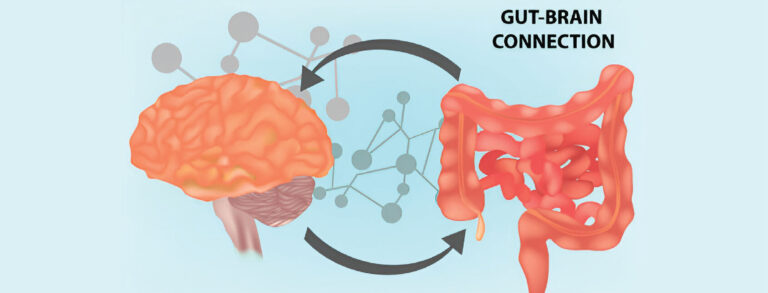
We often feel butterflies in our stomach when nervous, hungry when a big task is accomplished, or not able to eat before a big performance and many other such feelings that we feel in our gut. Or the non-proverbial gut-instinct. We are actually pretty spot on with this connection. Our brain and gut are connected, and interestingly, in a bidirectional way, where one’s state and activity influences the other’s state and activity.
The Gut-Brain Axis is considered as the important channel of this bio-communication between the brain, gut and its microbiome (the host of microorganisms within the gut that are crucial for digestion, immune responses). It involves connections and cross-talk between the autonomic nervous system, the central nervous system, the enteric nervous system (different types of neurons surrounding the intestinal tract) and the hypothalamic pituitary adrenal axis (HPA – a part of the limbic system affecting stress, memory and emotion systems)
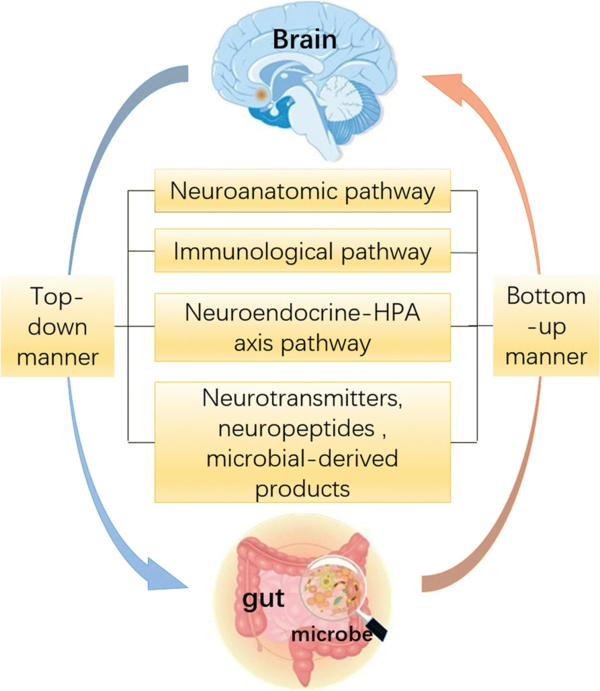
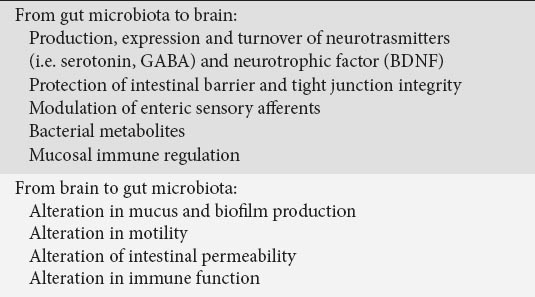
Figure adapted from Zhao et al. (2018) and Carabotti et al. (2015).
“This system not only keeps the gut working, but plays a central role in health and disease and perhaps even in our experience of the mind.”
— Julia Kaltschmidt (On the enteric system)
But there is another important player in this conversation: the trillions of microorganisms that live inside our gastrointestinal tract. Collectively known as the gut microbiome, these bacteria, fungi and other microorganisms are not simply passive residents helping us digest food. They interact continuously with the intestinal lining, immune system, nervous system and the chemicals produced by our bodies. In doing so, they become part of a much larger biological network connecting the gut and the brain.
The microbiome can influence this communication by producing or modifying a range of biologically active molecules, including short-chain fatty acids and metabolites involved in tryptophan and bile-acid metabolism. It can also influence immune signalling, intestinal barrier function and neural signalling. Conversely, what happens in the brain, including stress and changes in autonomic and hormonal activity, can alter the gut environment in which these microorganisms live. Thus, it may be more accurate to think of the microbiota-gut-brain axis as a dynamic ecosystem rather than a one-way pipeline from the gut to the brain.
Experimental work on mice suggests a critical period in which the microbiota in the gut influence the Gut-Brain axis thus affecting brain development in younger years. Further, it showed that microbiota even influenced neural plasticity such as reversing the stress-related effects. (Sudo et al., 2004).
If this communication is so deeply integrated into normal brain function, what happens when the system is disturbed?
This is where the gut-brain axis becomes particularly interesting in neuroscience and mental health. Changes in the gut microbiome, intestinal barrier, immune signalling and gut physiology have been associated with a range of conditions involving the brain, from stress, anxiety and depression to schizophrenia and neurodegenerative disorders. Research in this area is still evolving, and an important distinction is whether gut changes are a cause, a consequence, or part of a feedback loop accompanying the disorder. Nevertheless, the evidence has made the gut an increasingly important part of the conversation about brain health.
Parkinson’s disease provides one particularly intriguing example of this possibility. Constipation and other gastrointestinal disturbances can occur before the characteristic motor symptoms of Parkinson’s disease, and researchers have proposed that, in a subset of patients, pathological changes may begin in the gastrointestinal system and subsequently travel towards the brain along neural pathways including the vagus nerve (Chang et al., 2024). This has led to the idea of a “gut-first” or “body-first” subtype of Parkinson’s disease. Importantly, this is not thought to describe every person with Parkinson’s disease: current models also include a “brain-first” pathway in which pathology begins within the nervous system.
The idea is fascinating because it turns a seemingly ordinary symptom—something as mundane as altered bowel function—into a possible window into processes occurring much deeper within the nervous system. It also illustrates why the gut-brain axis is being studied not only as a communication pathway, but potentially as an early marker of disease and a possible site for intervention.
An interesting documentary on the role of gut health and gut microbiome on overall well-being available on Netflix: “Hack Your Health: The Secrets of Your Gut”
Parkinson’s is only one example. Similar questions are being explored in conditions much closer to our everyday experience of mental health. Research has linked alterations in the microbiota-gut-brain system with depression, anxiety, stress-related disorders and schizophrenia, while other work has examined relationships with cognition, learning and memory. Proposed mechanisms include changes in immune signalling, microbial metabolites, HPA-axis activity, vagal signalling and the availability or metabolism of neuroactive compounds.
This does not mean that there is a single “depression microbiome” or that changing one’s gut bacteria can simply cure a psychiatric disorder. Human studies are still trying to disentangle cause from consequence and determine how much these relationships vary between individuals. What is becoming increasingly clear, however, is that brain function cannot always be understood by looking at the brain in isolation.
References:
Aburto, M. R., & Cryan, J. F. (2024). Gastrointestinal and brain barriers: Unlocking gates of communication across the microbiota–gut–brain axis. Nature Reviews Gastroenterology & Hepatology, 21(4), 222–247. https://doi.org/10.1038/s41575-023-00890-0
Banellis, L., Rebollo, I., Nikolova, N., & Allen, M. (2025). Stomach–brain coupling indexes a dimensional signature of mental health. Nature Mental Health, 3(8), 899–908. https://doi.org/10.1038/s44220-025-00468-6
Bhatia, N. Y., Jalgaonkar, M. P., Hargude, A. B., Sherje, A. P., Oza, M. J., & Doshi, G. M. (2023). Gut-brain axis and neurological disorders: How microbiomes affect our mental health. CNS & Neurological Disorders – Drug Targets, 22(7), 1008–1030. https://doi.org/10.2174/1871527321666220822172039
Bowen, R. (n.d.). Gastrointestinal slow waves. In Pathophysiology of the digestive system. Colorado State University. https://vivo.colostate.edu/hbooks/pathphys/digestion/basics/slowwaves.html
Carabotti, M., Scirocco, A., Maselli, M. A., & Severi, C. (2015). The gut–brain axis: Interactions between enteric microbiota, central and enteric nervous systems. Annals of Gastroenterology, 28(2), 203–209. https://doi.org/10.20524/aog.2015.0051
Migrating motor complex. (n.d.). In ScienceDirect Topics. Elsevier. Retrieved September 30, 2026, from https://www.sciencedirect.com/topics/medicine-and-dentistry/migrating-motor-complex
Peristalsis. (n.d.). In ScienceDirect Topics. Elsevier. Retrieved September 30, 2026, from https://www.sciencedirect.com/topics/biochemistry-genetics-and-molecular-biology/peristalsis
Sah, R. K., Nandan, A., Athira, K. V., Prashant, S., Sathianarayanan, S., Jose, A., Venkidasamy, B., & Nile, S. H. (2024). Decoding the role of the gut microbiome in gut-brain axis, stress-resilience, or stress-susceptibility: A review. Asian Journal of Psychiatry, 91, Article 103861. https://doi.org/10.1016/j.ajp.2023.103861
Sudo, N., Chida, Y., Aiba, Y., Sonoda, J., Oyama, N., Yu, X.-N., Kubo, C., & Koga, Y. (2004). Postnatal microbial colonization programs the hypothalamic–pituitary–adrenal system for stress response in mice. The Journal of Physiology, 558(1), 263–275. https://doi.org/10.1113/jphysiol.2004.063388
Yin, J., & Chen, J. D. Z. (2013). Electrogastrography: Methodology, validation and applications. Journal of Neurogastroenterology and Motility, 19(1), 5–17. https://doi.org/10.5056/jnm.2013.19.1.5
Zhao, L., Xiong, Q., Stary, C. M., Mahgoub, O. K., Ye, Y., Gu, L., Xiong, X., & Zhu, S. (2018). Bidirectional gut-brain-microbiota axis as a potential link between inflammatory bowel disease and ischemic stroke. Journal of Neuroinflammation, 15, Article 339. https://doi.org/10.1186/s12974-018-1382-3